
Email Analysis
Check suspicious email content with our browser extension on supported email services, or paste it into the checker below.
Founders Edition
First 250Get IsThisSpam Personal protection for life for A$99 once. No subscription.
Don't Trust. Verify.
Instantly verify suspicious emails, texts, and websites.
Add a screenshot or PDF
We extract text with OCR, then use the existing text scam checker. Images are not analyzed by a vision model.
Images up to 4 MB. PDFs up to 10 MB and 5 pages. Mixed-content PDF pages with selectable text may omit text embedded in images. The file itself is not saved; submitted text follows the existing scan flow.
Quick test
Simple 3-Step Verification
IsThisSpam analyzes message metadata, page contents, sender patterns, and language style to supply instant threat verdicts.
Copy any suspicious email body, SMS text message, sender address, phone number, or URL and paste it into the checker.
Our safety-tuned model scans for urgency markers, check domain age and WHOIS records, and queries malicious databases.
Receive a clear "Low Risk", "Needs Caution", or "High Risk" verdict along with key warning indicators and recommended responses.
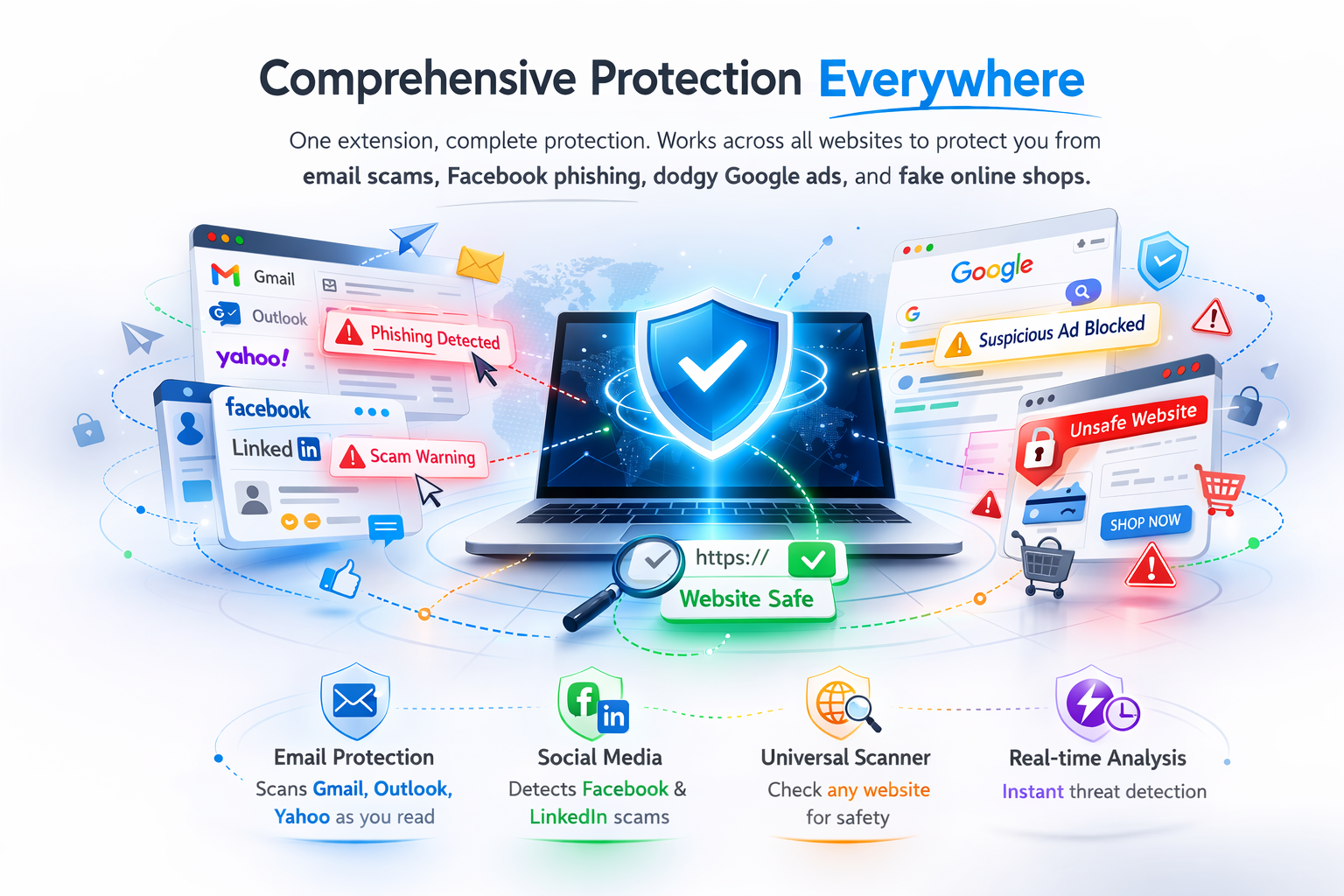
Comprehensive Protection
Check suspicious email content with our browser extension on supported email services, or paste it into the checker below.
Our online website checker allows you to check if a website is safe. Or use our extension to check websites as you are browsing.
Optional email scanning in supported Gmail, Outlook web, and Yahoo pages after you install the extension and enable the relevant permissions.
Most Popular
The browser extension adds checks in supported email and browser pages. Coverage depends on your browser, extension version, and enabled permissions.
Developer API & Open Source Model
Get API evaluation access or download our beta open-source model.
Scam Protection
IsThisSpam protects you from the most common online threats. Learn what to watch out for.
Deceptive emails or texts pretending to be from trusted institutions like banks or government agencies. They trick you into sharing passwords, credentials, or multi-factor authentication (MFA) codes. Look for urgent language like "account suspended," generic greetings, and mismatched domain names in the sender's address or links.
Fake e-commerce storefronts offering highly discounted popular items, electronics, or designer brands that never arrive. These sites often use brand names with slight variations or extra words (e.g., "discount-brand.com") and have no verified physical contact information. Check for missing HTTPS certificates, domain age less than 3 months, and payment terms that demand crypto, gift cards, or bank transfers.
High-yield investment schemes, cryptocurrency giveaways, and "get-rich-quick" opportunities promoted on social media or direct messages. They promise high guaranteed returns with little to no risk, which is a key mathematical red flag. Scammers often pressure you to act immediately, request payment via untraceable digital assets, and show fabricated earnings dashboards.
Scammers create fake online profiles on dating apps or social media, building deep emotional trust over weeks or months. Once trust is established, they fabricate urgent emergencies (e.g., medical crises, frozen bank accounts, or travel costs) to request wire transfers or gift cards. Key detection signals include requests to move communication off the original platform, refusal to video call, and stories that constantly change.
Deceptive pop-ups, search ads, or emails claiming your computer is infected with viruses, warning that your personal data is at risk. They instruct you to call a toll-free number where a "technician" asks to download remote-access software (like AnyDesk or TeamViewer) to fix the issue. Legitimate tech support departments will never contact you proactively via pop-ups to ask for remote access.
Fake package tracking notifications sent via SMS or email, mimicking postal services like USPS, DHL, or FedEx. They claim a parcel is held due to an incorrect address or unpaid customs fees, requesting a small fee and personal details to schedule redelivery. Spot these by checking the URL—official postal services do not use random domains (e.g., "usps-redelivery-fees.top").
FAQ
Find answers to common questions about IsThisSpam, AI detection capabilities, and user privacy.
Pricing Tiers
Choose protection for yourself or your team. All web plan prices are shown and charged in US dollars (USD), wherever you are.
Get clear explanations before you reply, click or pay. Features depend on your platform, permissions and completed setup. Automated checks cannot guarantee safety.
Continue one investigation without a subscription.
$4.99 USD once
Current investigation only. Valid for 24 hours.
Start with the free investigation. The pass is offered inside that case when you need more. It is not the standalone evidence-report purchase.
Scam checks and investigations for everyday use.
Checking price...
We will not guess a price or start an unverified checkout.
Protection for you and one invited person.
Checking price...
We will not guess a price or start an unverified checkout.
Protection for your household: you plus up to 10 invited people.
Checking price...
We will not guess a price or start an unverified checkout.
Already paid through an app store or a lifetime offer? Use the account linked to your purchase and check your access before subscribing again. Plan coverage and account linking can differ by purchase channel.
A one-time deep evidence report may be offered after an eligible scan for A$9 AUD. This is separate from USD subscription plans.
What our users have to say about us.
"I have been using their services for over a year, and they are excellent for security. First, they offer fully offline options so you can choose your data usage AI models. They allow Ollama and cloud AI providers for their tools. I love that they catch phishing pages on every device, including iOS! Their UX has improved over the year and continues to get better. I have used their browser extensions across platforms, and they are a must-have for personal and business use. They have helped my family members spot scams! The company is responsive to issues when they arise and is very forward-thinking. Please keep up the hard work."
Get Protected
Join thousands of users who trust IsThisSpam to detect threats that others miss. Powered by advanced AI to keep you safe.